
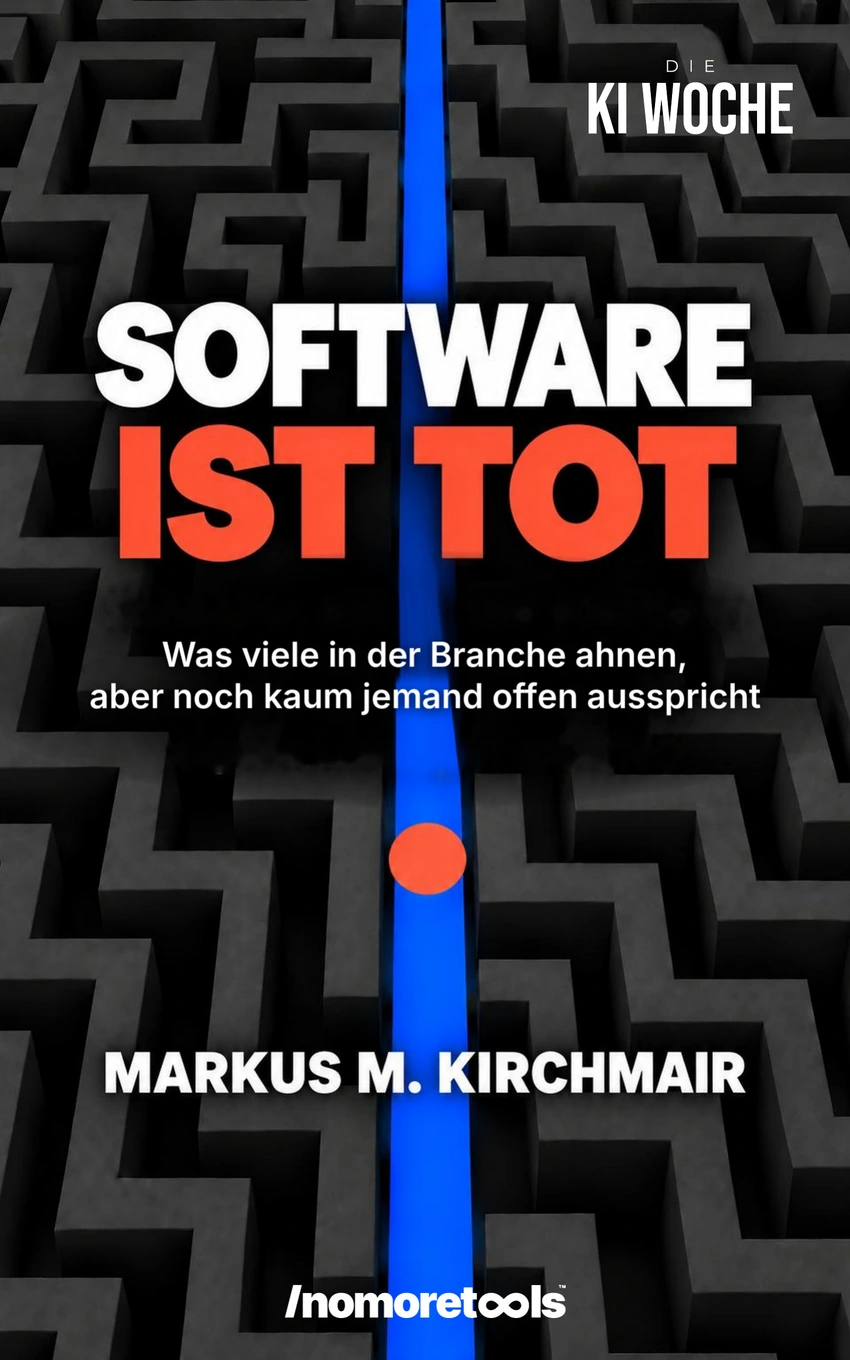
The book by Markus M. Kirchmair
Software
is dead.
What many in the industry suspect, but few say openly.
There will be more software. That does not mean more finished software products will be bought.
The book examines the changing application layer, its limits and the decisions within an individual business. Under nomoretools, the author works with businesses on implementing this approach. He discloses this commercial connection in the book.
The linked editions are in German. Current editions and conditions are provided by the retailer.
The argument
A thesis. And your own test.
Why does the easier creation of functions change the reason to buy a product? What remains valuable? When should a business buy, connect, build or leave something out?
Fifteen chapters move from the economic thesis to architecture and a testable first trial. An explicitly schematic delivery-date example connects the parts. Four groups of templates support inventory, purchasing and contract checks, full-cost comparison, decommissioning and pilot planning.
The counterarguments belong in the discussion: new dependencies, maintenance, security, responsibility and the limits of current evidence. The author applies the same tests of evidence, full costs, risk and the ability to switch providers to his own service.
From argument to practice
Test the idea
against your work.
The interactive examples show what a shared state, permitted execution and a visible decision can mean in everyday work.
The expanded argument
One expert.
More work within reach.
The German book examines how AI changes development and ongoing maintenance, and why individual expertise can coordinate much more work. It connects that capacity with deliberately simple interfaces and reasoned decisions.
Maintenance, responsibility and security remain requirements. The book compares how they can be met under changing conditions, distinguishing documented cases, personal experience and forecasts.
Your first step
Say yes
to less.
Less unnecessary software. More room for your work. Let’s find the useful first step.